
News & Views · Strategy
Your competitive edge isn't the algorithm. It's the human sitting next to it.
Everyone rushed to hand their content to AI. Now the smart money is quietly buying back the one thing a machine can't fake - a genuinely good idea.
Why has everyone suddenly gone quiet about "just letting AI do it"?
Two years ago the pitch was intoxicating: feed a prompt to a chatbot, get a month of content back before your coffee went cold. Plenty of businesses did exactly that - poured money and faith into AI for their content and social - and for a while the sheer volume felt like winning.
Then the engagement numbers came in, and a quieter trend started underneath the hype. Companies that automated their creative are increasingly circling back to agencies and human-led work for the thing AI couldn't buy them: an edge. Not more content. Better content. The kind that makes someone stop scrolling, actually reply, and remember your name a week later.
This isn't just our hunch. Samira Ansari - Australian-born chief creative officer of Grey US - told The Australian that the "AI panic" is easing and brands are rediscovering the value of big creative ideas. Global clients, she says, chased in-house production and influencer marketing, found it could drive short-term sales but wasn't building enduring brands, and are now coming back to agencies for the strategy and the ideas.
We forgot about ideas, because that's how people have relationships with brands.
It's a real correction. Big players had piled into the creator economy and handed production to AI - Unilever famously committed half its media budget to social and creators. Turns out you can find the influencers and make the sales, but as Ansari puts it, that still leaves the question nobody automated an answer to: what's the idea?
None of this is an anti-AI sermon - we're marketers, not luddites, and "never stop learning" is practically stitched into our letterhead. AI is a genuinely brilliant tool. But a tool is what it is. The businesses pulling ahead aren't the ones who handed over the keys; they're the ones who kept a human in the driver's seat and used AI to make the trip faster.
Does human-created content actually perform better - or does it just feel nicer?
The software company Planable ran a genuinely useful experiment: one fictional chocolate brand, seven Instagram accounts, some run by professional social media managers and some run entirely by AI (ChatGPT and Claude), all competing on equal footing with identical ad budgets. The results are worth a read if you've ever wondered whether the robots have caught up.
Here's the bit that should reframe how you think about it. AI didn't lose for lack of reach. Both sides got seen roughly equally. The difference opened up after the impression: humans turned attention into likes, comments and shares, while the AI mostly turned attention into a scroll. As one of the human managers put it, the thing AI couldn't do was engage with the actual people. It did the posting - the easy 30% - and skipped the 70% that's replies, DMs and turning up in someone else's comments.
The post is 30% of the work. The other 70% is active distribution - and that's the part you can't hand to a machine.
But hasn't AI officially beaten humans at creativity? I've seen the headlines.
A major study led by researchers at the Université de Montréal (with AI pioneer Yoshua Bengio involved) pitted leading models - ChatGPT, Claude, Gemini and others - against over 100,000 human participants on tests of original thinking. The finding was a genuine turning point: generative AI can now out-do the typical human on certain creativity tasks. That's the headline everyone quoted.
The sentence underneath is the one that matters for your business: the most creative half of humans outperformed every AI system tested, and the top 10% held a wide, clear advantage. Creativity turns out to be a spectrum - machines bunch up in the middle of the pack, while humans stretch all the way to the top. AI is exceptional at finding the average of everything that already exists. It interpolates beautifully. What it doesn't do is extrapolate - connect a 19th-century building to a marketing campaign, or wire a supply-chain fix to something borrowed from biology. That leap is still a human move.
Which is really just common sense with data attached. "Sounds like everyone else, only faster" is not a market position. If your content is the statistical average of your competitors' content, congratulations - you've built a beautifully efficient way to blend in.
So the fear that AI will replace creatives is... overblown?
Here's a tidy irony worth sitting with. Fear is one of the most reliable creativity-killers there is - when we're anxious, the brain retreats into safe, familiar, defensive patterns, which is the exact opposite of the flexible, connective thinking that produces a genuinely new idea. A lot of businesses have spent two years quietly panicking about AI, and that fear has done more to freeze their creativity than AI ever could.
Ansari puts it more bluntly than we'd dare: panic makes you play safe, and safe work is the real killer. Unless the work is interesting, entertaining or useful, she says, you're just making wallpaper - which is essentially burning your money. And here's her sharpest observation, the one worth pinning above the desk:
AI highlights the mediocrity in our work. The boring, repetitive, familiar stuff gets done by AI - because that's exactly what AI pulls from.
Read that twice. If AI can already do your marketing, that's not a compliment to the AI - it's a warning about your marketing. The stuff a machine can replicate is, by definition, the stuff that was already average. Which flips the whole fear on its head: AI isn't coming for the great ideas, it's exposing the absence of them.
The unlock, then, is to stop treating AI as the thing coming for the ideas, and start treating it as the thing that clears space for them. Point it at the grunt work - the first drafts, the research, the ten rough variations, the formatting - and suddenly your people have hours back to do the part only they can do: judge, connect, refine, and have the odd flash of brilliance no prompt would ever have produced. Better still, Ansari reckons the corner is exactly where creativity thrives: tight briefs, tight budgets and a bit of chaos tend to sharpen ideas, not smother them. Good work, she says, will always get you out of trouble - for a career or a brand. The fear thaws. The big ideas come back.
The pattern that actually wins
In Planable's experiment, the strongest AI-assisted account wasn't run by someone who let the machine loose. It was run by a professional who used AI to produce - then used her own judgement to decide what actually shipped, and fixed it by hand where it fell short. She logged more hours than anyone, including every fully-AI account combined.
The lesson isn't "AI saves you time." It's "AI changes what you spend time on" - less blank-page drudgery, more directing, choosing and adding the human touch. A subscription is not a substitute for a person's taste.
How do I actually use AI without losing the human edge?
The mechanics look like this:
- Human prompts, AI produces. Start with a person who knows the brand, the town and the customer. Let them brief the AI and generate a pile of raw ideas, angles and drafts in minutes.
- Human chooses. The single most important step, and the one everyone skips. A person decides what's actually any good - what's on-brand, what's true, what's got a spark. The machine offers; the human picks.
- Human creates from there. Treat the best AI output as a jumping-off point, not a finished product. The interesting idea it half-suggested becomes the seed a person grows into something distinctive.
- Human does the talking. Every reply, comment and conversation stays human. That's where loyalty is built, and - per the data above - it's where the entire performance gap lives.
- Human checks the facts. AI is confident even when it's wrong. Every stat, claim and name gets verified against a real source before it goes out. (Yes, including this article. Especially this article.)
Notice the machine appears in every step and runs none of them. That's the whole trick.
What has any of this got to do with getting people through my door?
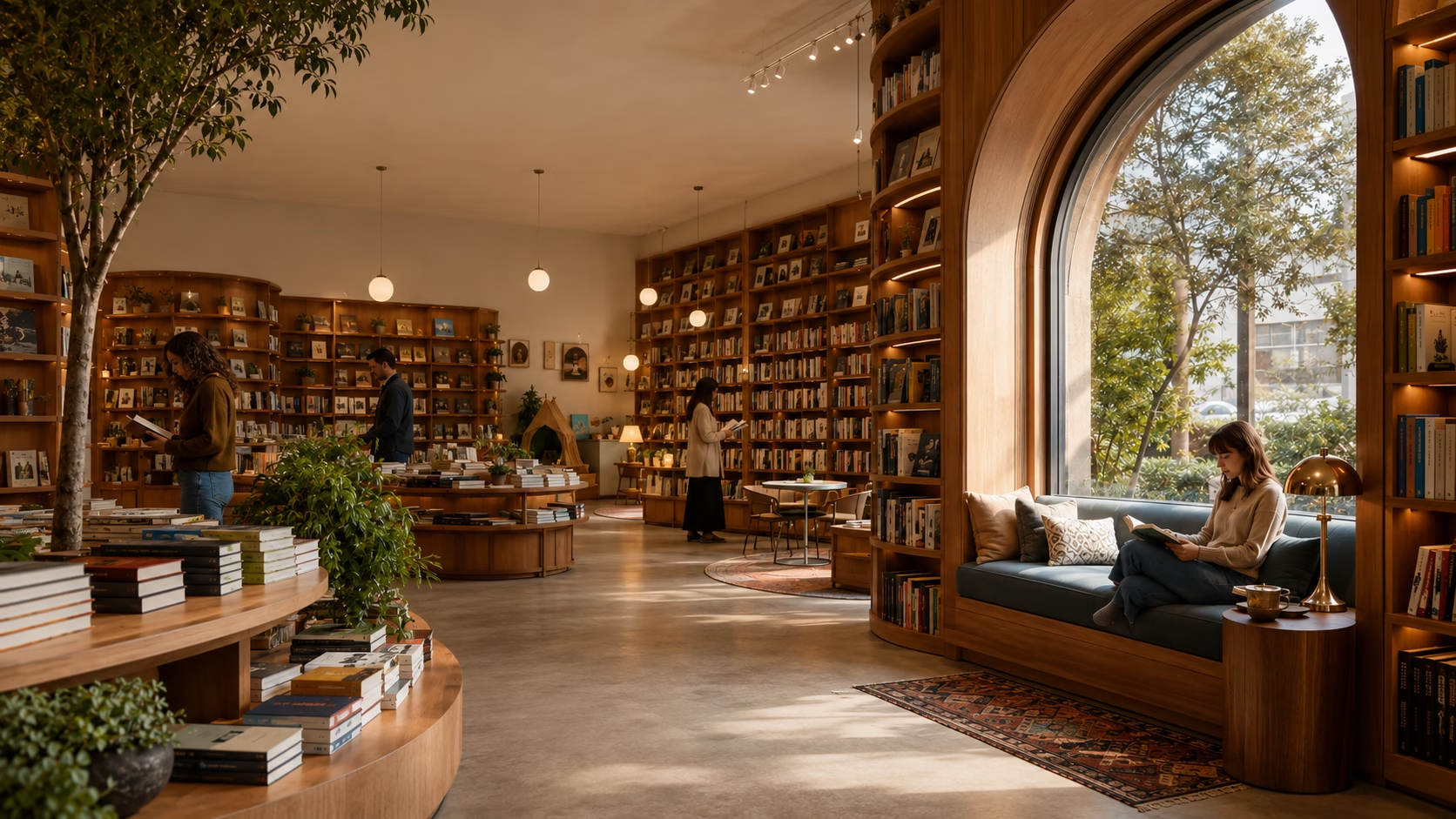
Everything - because it's the same principle wearing different clothes. Last time we talked about dragging shoppers off the couch and into your store, and the winning move was offering something the screen simply can't hand over: the tactile, the curated, the human "an actual person who knows their stuff." Online can beat you on price and convenience every day of the week. It cannot beat you on a Saturday-morning experience, a real conversation, or a shopkeeper who remembers your dog's name.
Human-led creativity is the online version of exactly that. Whether it's a beautifully designed post or a beautifully arranged shop window, the thing that differentiates you from your digital competition is the same thing in both places: an intrinsic, hard-won human instinct for what other humans actually want and need. A machine can guess the average. A person who knows the community can feel it.
Online wins on price. It cannot win on the human read of what people want - and that's true on your shelf and on your feed.
That's your genuinely un-copyable advantage. The mid-tier chains that offered nothing a digital interface couldn't replicate are the ones struggling most. The same is true of content. Generic, automated, average-of-the-internet marketing is the online equivalent of a soulless shopfront - technically open, but why would anyone stop?
Right then - where do I start?
You don't need a lab, a data science team, or a subscription to every AI tool going. You need one honest audit and a few good habits.
- Find your grunt work. List the repetitive, blank-page tasks eating your team's week - first drafts, research, resizing, rough variations. That's AI's job now.
- Free the humans for the good bit. Redirect the hours you claw back into ideas, taste and conversation - the things that actually move the needle.
- Put a person on the final call. Never publish AI output unread. A human chooses, shapes and finishes everything that carries your name.
- Keep every conversation human. Replies, comments, DMs, the person who walks in the door. This is where the growth is - don't automate it away.
- Verify before you publish. Every fact checked against a real source. Confident and wrong is worse than slow and right.
Do that consistently and you stop competing with the digital revolution on its terms - endless, cheap, average - and start winning on yours: original, human, and unmistakably you. Keep the creative juices flowing, point the machine at the boring bits, and let your people do the one thing that's never going out of fashion: think of something nobody else did.
Encompass Marketing helps small businesses across Orange, Bathurst, the Central West, Sydney, the Blue Mountains and the Riverina turn ideas like these into a plan that actually gets done. If you'd like a hand blending smart AI use with genuinely human, genuinely creative marketing, we can help.
Encompass Marketing
encompassmarketing.com.au | Bathurst, NSW | Define. Design. Deliver